
Geophytes

Understanding Geophyte weeds

Corms, bulbs and tubers

Image
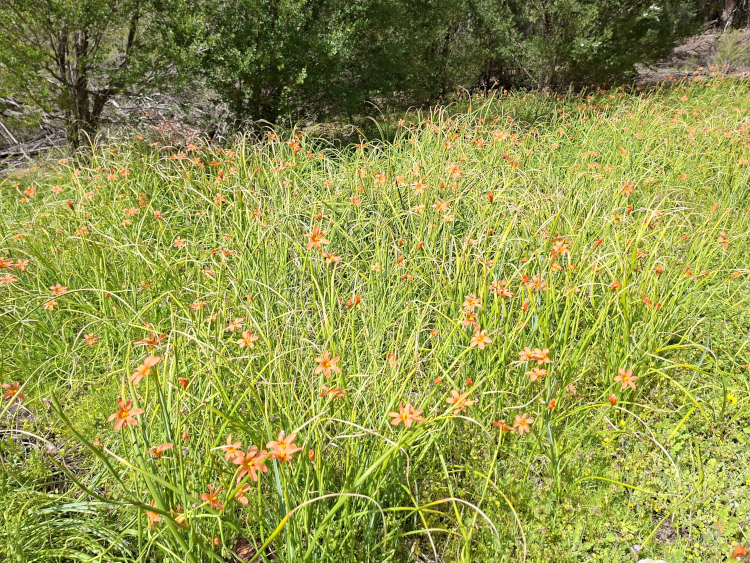
Cape tulip

Geophytes

A geophyte is an herbaceous plant with underground storage organs that enable it to survive harsh seasons or disturbances such as fire and grazing. Geophytes broadly fall into three categories; corms, bulbs or tubers—depending on the plant part that is modified to make up the storage organ. Around 95 % of geophytes introduced to south-west Western Australia come from the Cape Region of South Africa. Pre-adapted to the Mediterranean climate, the nutrient-poor soils and relatively frequent fires of south-west Western Australia, they pose a serious threat to bushland they invade. The ability to invade relatively undisturbed bushland makes them a particularly serious group of environmental weeds.

Understanding their life cycles and reproductive biology of geophytes are an important part of knowing how to prevent spread and achieve meaningful control.

Many geophyte weeds are often collectively called bulbs, but most are actually corms. Here are some examples of each:

CormsBulbsTubers
BabianaAmaryllisAsparagus
FreesiaAlliumZantedeshia
GladiolisLachenaliaAlstroemeria
HesperanthaOxalisColocasia
WatsoniaNarcissusSpirodela
Sparaxis Gloriosa
Moraea Cyperus
Ferraria  
Romulea  

Corms

Corms comprise underground swollen stems or stem bases which are annually renewed. That is, each year a corm (referred to as the parent) produces a new daughter corm, sometimes two, while it is actively growing. While producing the new corm, the parent corm slowly exhausts and dies. Sometimes the remains of the parent can be observed as a series of plates below large old corms of Watsonia or woody tunics on corms of Hesperantha. Some corms (e.g. black flag) produce a column of persistent perennial corms to which a new corm is added each year.

Cormous weeds are able to reproduce vegetatively in a variety of ways, such as:

  • Two or more daughter corms from the one parent corm;
  • Axilliary buds formed on parent corms that go to produce new plants when the growing shoot is removed;
  • Tiny ‘seed like’ cormels produced around the base of the parent corm or along stems.

Most species also reproduce by seed. Seed and cormels are the main mechanisms for medium to long distance dispersal.

Bulbs

Bulbs are made up of swollen leaf bases. Most bulbous weeds are summer dormant, sending up leaves as the temperatures drop with the first autumn rains. Flowering and seed set take place at the end of the growing season, in winter to late spring. There are exceptions though. The flowers of Easter lily (Amaryllis belladonna) and some others in the family Amaryllidaceae emerge in early autumn, often long before the first rains with the leaves appearing after flowering is finished.

Bulbous weeds reproduce vegetatively in a number of ways, such as:

  • produce offsets or daughter bulbs each year. Examples are perennial bulbs such as Amaryllis and Narcissus;
  • produce new bulbs and bulbils that arise from nodes along underground stems. Such as Oxalis
  • reproduce from bulbils formed around the base of the bulb, along underground stems and even along the base of leaves.   left lying around. Lachenalia bulbifera and L. reflexa can reproduce this way.

Bulbs can also produce from seed each year and this appears to be a major mechanism for dispersal into relatively undisturbed bushland.

Tubers

Tubers are swollen underground stems or roots that store nutrients and can represent a substantial proportion of a plant’s total biomass. They may develop from rhizomes (underground stems) and, in some species, form dense tuberous root mats, such as those produced by bridal creeper. Tubers can also occur as large, individual storage roots, sometimes referred to as rhizomatous tubers.

Vegetative reproduction in tubers is either via yearly expansion of rhizomes supported by a perennial tuberous root mat. The rhizomes give rise to a series of shoot buds along their length and new shoots always arise from the rhizome, never directly from a tuber. Tuberous plants also give rise to seed.