
There are many ways to manage and control weeds. Selecting the right method of weed control can be a critical factor in the success of your weed treatment. Weed control methods should be considered as part of an Integrated Weed Management Plan, combining the methods that will be most effective in your weed situation to control weed populations and facilitate landscape restoration.
Control Methods
Weed control methods can be divided into four categories:
- Physical control involves physically removing weeds or parts of weeds by hand or machinery, and does not involve chemical use. Methods may be targeted or broad area, depending on the form of application.
- Chemical control employs the use of specially formulated herbicides to treat weeds. There are numerous herbicides and several methods of application, each developed to target a weed or group of weeds.
- Managerial control encompasses cultural and managerial practices, such as burning and revegetation, to directly or indirectly reduce or eliminate weed populations.
- Biological control, also simply known as 'biocontrol', utilises biological (living) organisms to naturally control other living organisms. In weed management, plant pathogens or insects that parasitise are the most common forms of biocontrol.
Follow the links below to learn more about each type of control.
Physical > Chemical > Managerial > Biological >
Integrated Weed Management
Integrated weed management (IWM)—a subset of integrated pest management—is a strategic approach for long-term management and control. It accepts that a single control method will not necessarily control a target weed. Instead, it combines several methods of control to target weeds and addresses the causes of weed infestations to obtain effective and economical weed control.
By implementing IWM plans, weed species are less likely to adapt to a single control technique, such as developing herbicide resistance. Using herbicides sparingly and effectively also reduces effects on non-target species and the environment.
Integrated weed management can be summarised into four steps, together forming an IWM Plan.
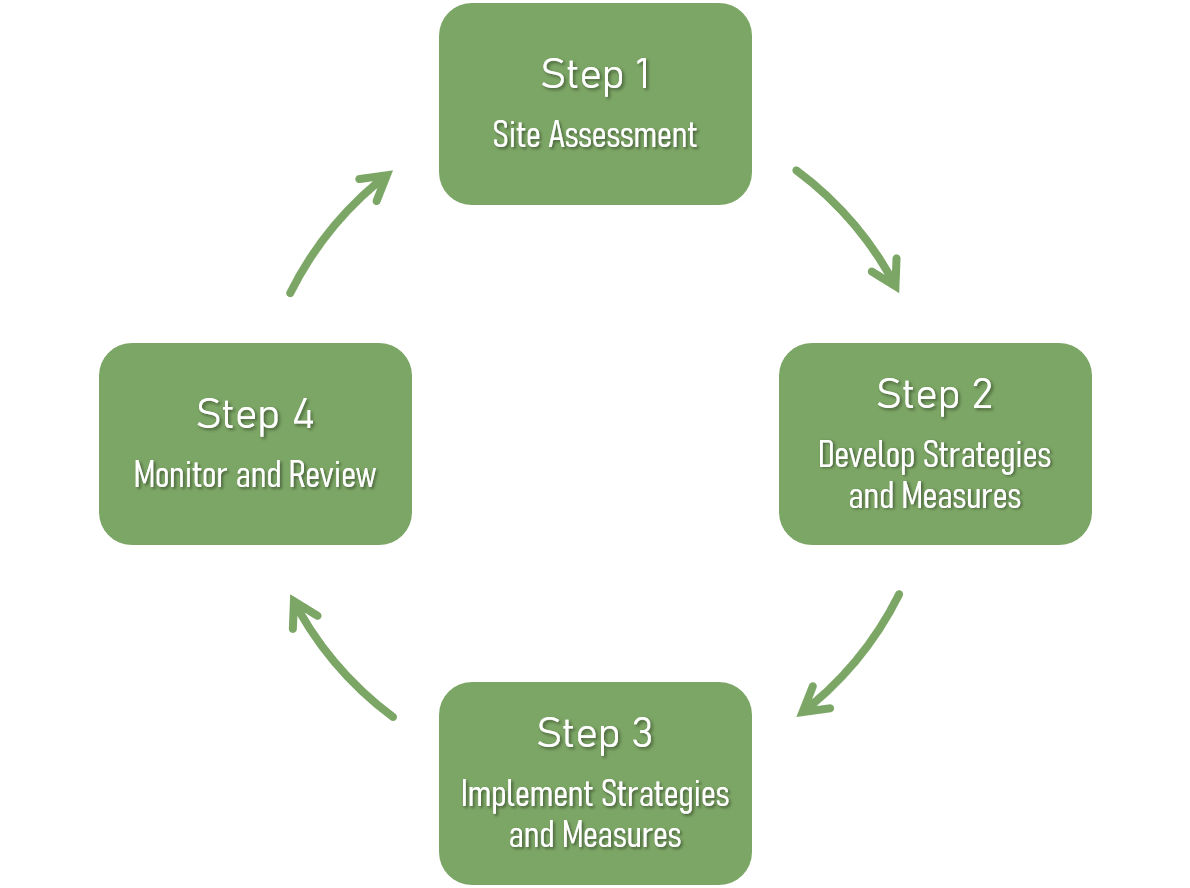
Step 1. Site Assessment
Identify weeds
Correctly identify and understand weeds to avoid confusing native flora with weeds, and to help decide on control options. Better understand key weed species by identifying qualities such as life cycle, behaviour, seasonal cycle, population dynamics and interactions.
See Identify a weed for resources to help with weed identification.
Map weeds
Map weeds to determine the size and density of the area you are dealing with. Mapping may help you determine the best control methods to use for the location. When mapping, consider
- Method—think about how to best map your site to ensure minimal impact on the bushland.
- Timing—the best time to map will be determined by the species you are mapping. Larger woody weeds, trees and shrubs that you recognise easily can be mapped at any time. For smaller shrubs, herbs, and grasses, it's best to map when in flower or at stages of their life cycle when they are easy to identify.
- Conditions—consider prevailing weather conditions and safety of site access before commencing work, e.g. boggy or wet road conditions.
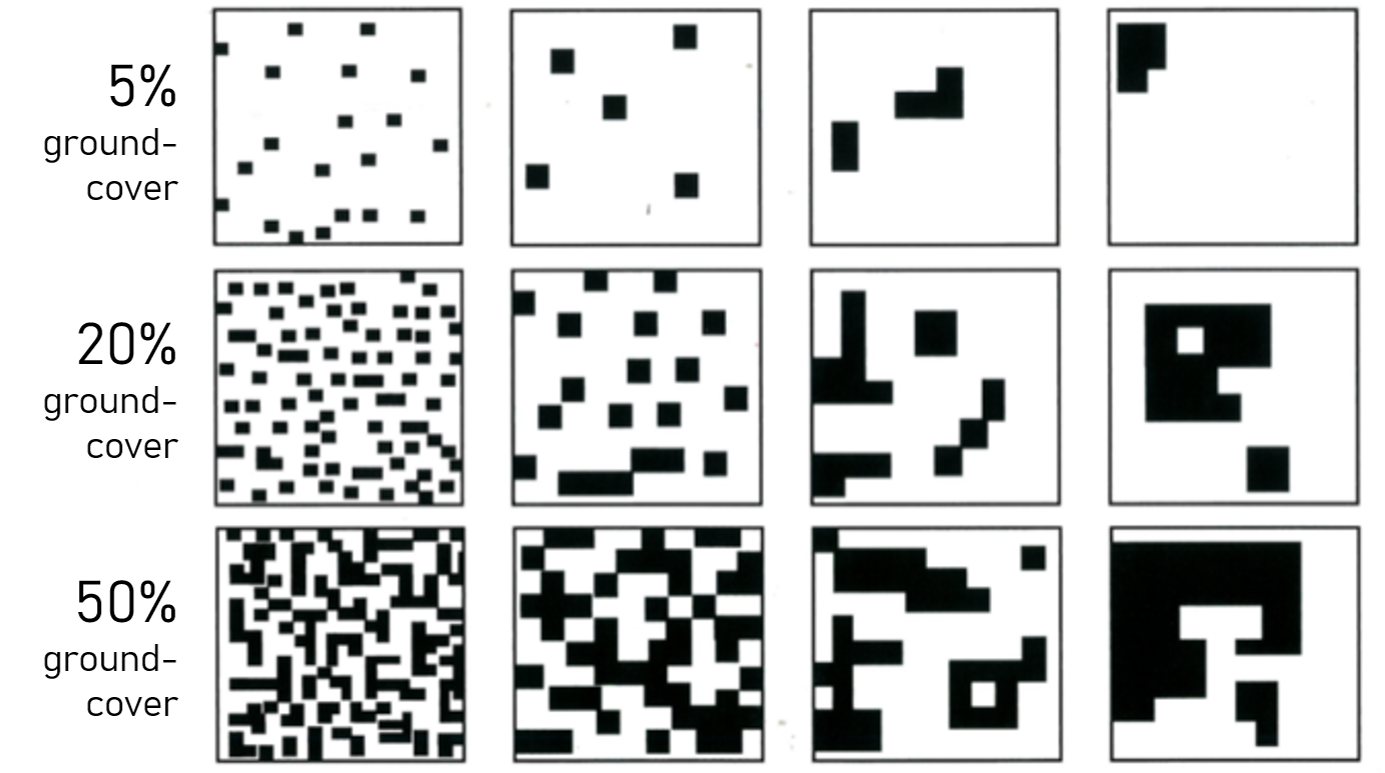
Determine weed coverage—changes in cover over time is a measurable source of information that can indicate effectiveness of control. Visually estimating weed cover is the most common method, but may vary slightly between observers. Weed coverage can be estimated as a percentage of groundcover, usually using an incremental scale. DBCA uses the following weed coverage increments: 0%, <5%, 6-25%, 26-50%, 51-75%, 76-100%. The visual guide below illustrates how different percentage cover may appear.
Understand why weeds are present
How did those weeds get there? Understanding why weeds are present helps with weed management by allowing you to target the source of the infestation. Weeds may occur due to a number of reasons, such as:
- dumping of garden waste,
- spreading from road verges,
- poor hygiene (seeds dispersed in soils or vehicles),
- imported materials.
Identify assets, risks, and other management issues
An important part of site assessment is identifying assets such as other vegetation and animals present on site; what you are protecting and where management intervention would have the most impact; and risks and other management issues which may affect your work on site.
Assets to consider:
- Sensitive areas like waterways, residential, grazing, organic production, etc.
- Are there sites, species, or objects that hold cultural signifiance?
- Are there native or other non-target plants in close proximity?
- Are the weeds providing habitat or some other ecological function?
- Are there native fauna who are sensitive to some weed control methods?
Risks to consider:
- Spray drift—consider weather and surrounding native flora to minimise off-target damage.
- Neighbours—do you need to inform neighbouring landholders? Are there weeds on adjacent properties which will spread and reinfest your site?
- Safety risks—to the health and safety of personnel doing the work, and any public safety risks.
- Erosion—caused by the loss of stabilising effects of the weed root systems.
Management issues to consider:
- What is the size of the project area?
- Is the terrain trafficable, flat, undulating, steep, rough?
- Is it accessible by vehicle, 4WD, ATV, or foot only?
- What time of year will you be undertaking management actions?
- Is there Phytophthora dieback in the area? What hygiene procedures will you put in place?
- Who else uses the area and what other stakeholders would you need to consider?
In considering all the above, think about the objectives of your weed management.
Step 2. Develop Strategies and Measures
Identify priority assets and weed threats
At a regional level, determine priority areas. At a site level, determine priority assets for protection and priority weed threats to target for management. Refer to assets identified in your site assessment and prioritise based on weed risk and feasibility to manage.
Set measurable objectives
Objectives are statements of intended measurable outcomes to achieve in the short-term (1-2 years), medium-term (~5 years), or long-term (~10+ years). Set S.M.A.R.T. objectives to achieve priorities—such as abatement of critical threats (weeds) or restoration key ecological assets—using available resources.
S.M.A.R.T. objectives are Specific, Measurable, Achievable, Relevant, and Time limited.
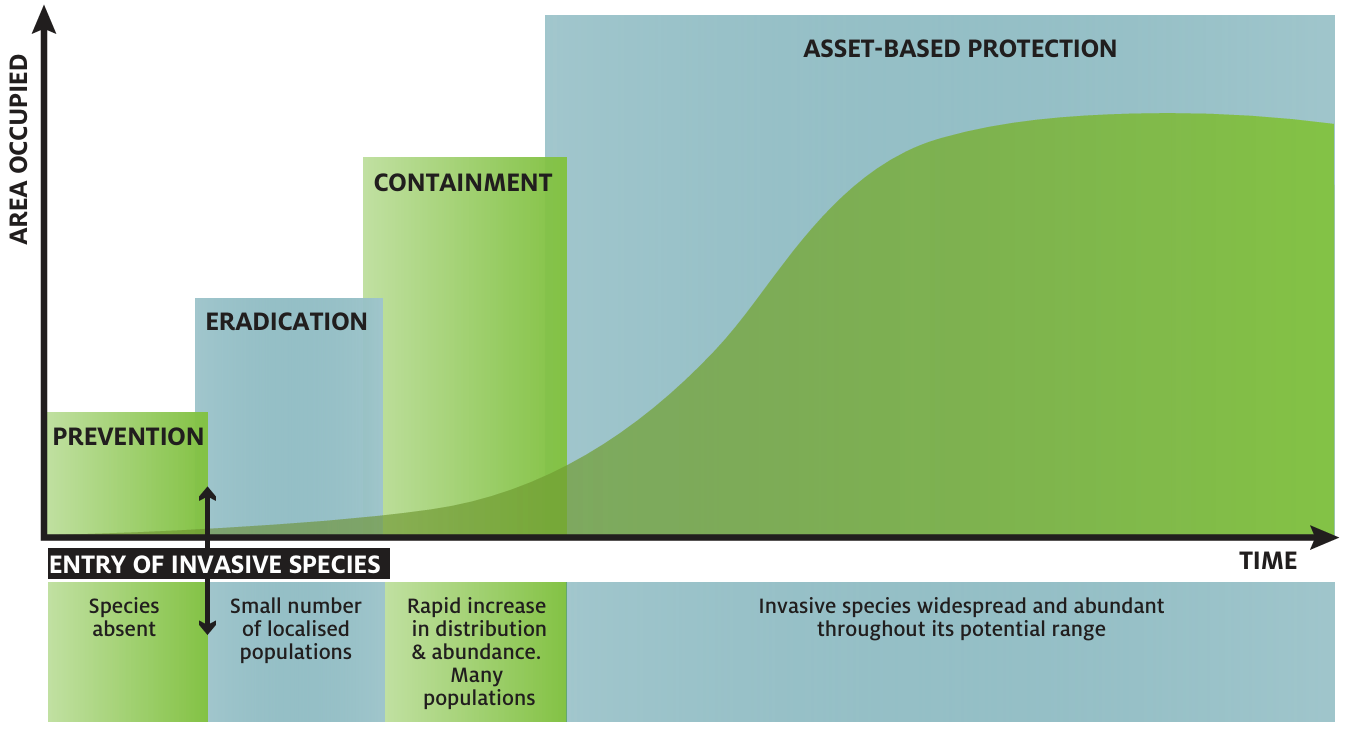
When determining your objectives, it is important to consider the main management approaches, particularly eradication and containment. It is more feasible to eradicate weeds that are in the early stages of invasion, rather than those that have become widespread. Large areas with long established infestations may not be suitable for eradication, but containment prevents further spread and environmental damage.
Containment of a weed to prevent and control new infestations is a more realistic management approach when faced with widespread and well-established species. Once a weed species is beyond eradication, the best option is to contain it and prevent further spread.
Define actions required
This is where the method of control is determined. Refer to Control Methods for further detail on physical, chemical, managerial, and biological control options. Actions are the interventions required to achieve the objectives set. A good action should meet the following criteria:
- Linked—directly related to a specific objective.
- Focused—maximises the effectiveness for achieving the objective.
- Feasible—accomplishable in light of the project's resources and constraints.
- Appropriate—acceptable to and fitting within the project-specific cultural, social, and ecological norms.
Consider tactics and aims for undertaking actions. For example: deplete the weed seedbank; kill/remove weeds in the target area; prevent new seeds being added to the soil seedbank; or prevent introduction of viable weed seed from external sources.
Define measures: monitoring and evaluation
When defining measures, consider (1) strategy assessment—What will we measure to assess progress towards objectives?—and (2) strategy effectiveness—How will we measure effectiveness of actions?
Identify indicators—measurable attributes related to specific information—such as change in weed threat, or health of the native vegetation. Indicators can be quantitative measures such as percentage cover, or be qualitative observations such as photopoints showing change over time.
Maintain a long-term view
Determine actual long-term commitment of labour and resources available. Ensure that follow-up control and monitoring is factored into works programs to achieve objectives. Weeds won't be eradicated overnight, it is often a slow process that takes several years.
The overall objective may be to eradicate a particular population of weeds; however, smaller milestone objectives may be put in place in order to achieve the overall eradication objective. For example, it may only be feasible to reduce a weed population by 20% per year, thus giving a total of five years to eradicate with an additional two years monitoring to ensure eradication has been achieved.
Step 3. Implement Strategies and Measures
This stage is about getting the weed management done. Agree on time-lined and measurable actions, develop a workplan, and get started. This includes setting up measurement methods such as photopoints or quadrats.
Implementing the strategies and measures developed in step 2 requires:
- Actions beging agreed-upon or approved,
- Roles and responsibilities being allocated,
- Measurable actions being time-lined, and
- Commencing and completing the works.
Step 4. Monitor and Review
Monitor implemented measures
Monitoring is a vital part of the weed management cycle and allows you to identify success or failure. By gathering further information through monitoring, you can adapt your weed management plan as needed to improve results and respond to changes in the environment. Monitoring and review requires baseline data—it is essential to know and record weed attributes before treatment so that you can assess effectiveness and adapt post-treatment.
Methods may include site mapping and recording observations to compare weed coverage, reproductive stage, area of infestation and control effectiveness over time; use quadrats to sample cover, density, species richness and presence/absence at specified intervals; or use photo points at predetermined intervals to provide an effective aid for communicating changes over time.
Read the monitoring after weed management article and associated manual published by NSW CCEEW.
Record
Record monitoring efforts to build comparison data that will show changes over time. Record weed occurrence—changes in area and density of weed population; and weed treatments—control actions including chemical application and other management activities.
These records will also provide evidence to support continued or further funding.
Learn from results
Critically reflect on the strategies and measures implemented—what worked and what didn't? Accept that miscalculations and oversights are inevitable and that lessons should be learned from them. Acknowledging 'failures' often inspires creative solutions. Don't persist with methods that do not work—it is a waste of time, effort, and resources.
If there is evidence supporting the success of particular control methods, continuing these methods may reduce the effort required in following years, as well as provide insight or options for other sites that have been previously difficult to control.
Adapt
Revise the IWM plan and identify where it fails to meet objectives. Modify or cease ineffective or damaging control actions, trial alternative methods to increase chance of success. Change the plan as situations change—for example, chemical control may be suitable or required for the first three years, then manual removal may be sufficient to clean up the remainder of weeds present at the site.
If several adaptions have been trialed and success has not been achieved, assess and determine whether the objectives and overall project is feasible and worth continuing.
Share findings
If it works—share your success! Let others know what has been effective. If it doesn’t work—share your results! Let others know what has been ineffective to save them the trouble of making the same mistakes.
Sharing both successes and failures provides others with successful methods and prevents them from making the same mistakes—saving time and resources. It enables a wider understanding of why some approaches are more successful than others and can help inspire creative weed management solutions. Shared knowledge assists future projects to run more effectively and efficiently.
Search and read our case studies to learn what has and hasn't worked in weed management.