
Knowing what weed you are dealing with is the first step in best practice weed management, so it is important to know how to identify them.
There are several ways to identify weeds, but lodging a specimen with the herbarium is the only method for obtaining a formal identification and record. Modern methods often rely solely on photographs, which is sufficient for most identification purposes. However, photographs cannot capture other details—such as scent, texture, scale, and habitat context—which are often important for accurate identification. See the tools and resources for identification listed below.
Books
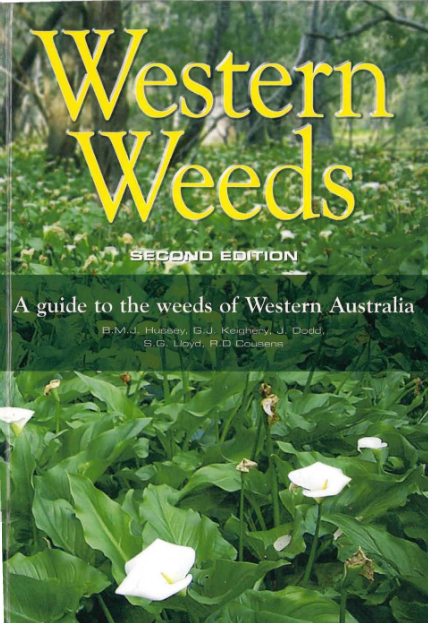
Western Weeds
Published by The Weeds Society of Western Australia, Western Weeds: A guide to the weeds of Western Australia is a must-have resource for weed identification in WA. The freshly updated third edition is on its way, but a pdf version of the 2007 2nd edition can be downloaded from the society's website.
Southern Weeds
For WA's south, Southern Weeds and their control by John Moore and Judy Wheeler is a great flip-book resource to have on hand. A pdf copy of the 2nd edition (2008) is available via the DBCA and DPIRD online libraries. The 3rd edition (2020) is only available in print.
Northern Weeds
For the Top End, Weeds of northern Australia: a field guide by Nicholas Smith is another great resource to have on hand.
Apps & Online Tools
There are several mobile apps and desktop websites available that can be used to aid in plant identification. We've listed the some below. These tools rely on good images to able to identify, learn how to take good shots with this General Guide to Photographing Plants on iNaturalist.
iNaturalist

The global citizen science app iNaturalist is the recommended app for identification and occurrence records—for all natural organisms, not just weeds! It uses a combination of image-classification models and human community members (including citizen scientists and subject-matter experts!) to identify observation records.
"Research grade" observations also get shared with the Atlas of Living Australia and other global data repositories, where they contribute to biodiversity knowledge and research.
WeedScan
 Powered by a CSIRO AI model trained on over 120,000 weed images, WeedScan is an identification, recording, and alert system for almost a thousand of Australia’s weed species. WeedScan is a free resource, available as a web or mobile app (Android and iOS), built by the Centre for Invasive Species Solutions (CISS) and other national and state government bodies.
WeedScan is for rangers, scientists, agronomists, farmers, community groups, and natural resource managers. Common garden weeds are not a focus of the WeedScan app.
Social Media
The Weeds of Western Australia public Facebook group is an active online community for anyone with interests or concerns about weeds in WA. It provides a platform for assisting in the identification of environmental and agricultural weeds, and acts as a forum for discussing methods of weed management.
Environmental Weeds of Australia Lucid Key
A Lucid key is an interactive identification tool that uses a dichotomous (or pathway) key to help you systematically narrow down and identify a specimen based on its characteristics. The Environmental Weeds of Australia Lucid key is made available through Weeds Australia. Read the handy guide notes for using the key provided on their Identify page. The key contains only 442 of Australia’s weed species, so may not get you to a definitive answer if your specimen is less common, but it will help narrow down your search!
Want to learn more about identifications keys? Read this handy introduction to identification keys by Lucid.
MyPestGuide

DPIRD WA's MyPestGuide is an app for reporting plant pests, diseases, weeds, animals, and aquatic organisms in Western Australia. Reports go to officers in the Pest and Disease Information Service (PaDIS), who will identify, respond with details, and take any legislative action where necessary for biosecurity concerns.
Please note that although identification is part MyPestGuide, it should be reserved for reporting suspected biosecurity concerns—such as presence of declared weeds.
Why are there different plant names?
The scientific name assigned to plants occasionally changes. This occurs when new information reveals insights about a plants' evolutionary history and their taxonomy is subsequently reviewed. For example, species of the weeds known as fleabanes were moved from the genus Conyza to Erigeron. Some resources may refer to the old name (nomenclatural synonym) or the current accepted one.
Sometimes, the accepted scientific name for a plant will also be different in other parts of the world. In Australia, the naming of plants follows the Australian Plant Census which is a curated consensus list of Australian native and naturalised plant names updated by Australian state and national herbaria. Internationally, the naming of plants may follow the Plants of the World Online supported by Kew Botanic Gardens. Both are major botanical databases, but they differ significantly in scope, purpose, and authority. Plant species taxonomy is always being reviewed by global herbaria, and the databases adopt these reviews at different times. Therefore, there will be times where a plant is known by one name in Australia, and another name overseas.
What about common names?
For identification and observation records, it is always best to use scientific names. Why? Many unrelated plants are commonly referred to by the same common name! This means that if a record only referred to a plant by its common name, it could be one of several different unrelated species.
The common name for a weed may also differ to what it is known as in its native range. Instead, the name given to a plant from where it is a weed will often reflect the negative connotations of the weed's behaviour. For example, stinking passionflower (Passiflora foetida) is known as love-in-a-mist in its native range. Similarly, Paterson's curse (Echium plantagineum) is known as blue echium or purple bugloss in its native range.
The common name displayed for plants in Bushland Weeds will be the most used or accepted name for that plant in Western Australia.