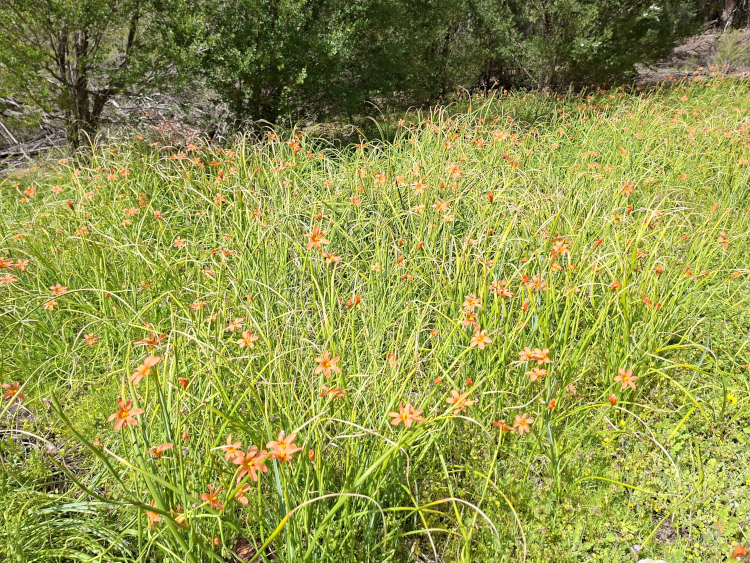

A geophyte is an herbaceous plant with underground storage organs that enable it to survive harsh seasons or disturbances such as fire and grazing. Geophytes broadly fall into three categories; corms, bulbs or tubers—depending on the plant part that is modified to make up the storage organ. Around 95 % of geophytes introduced to south-west Western Australia come from the Cape Region of South Africa. Pre-adapted to the Mediterranean climate, the nutrient-poor soils and relatively frequent fires of south-west Western Australia, they pose a serious threat to bushland they invade. The ability to invade relatively undisturbed bushland makes them a particularly serious group of environmental weeds.
Understanding their life cycles and reproductive biology of geophytes are an important part of knowing how to prevent spread and achieve meaningful control.
Many geophyte weeds are often collectively called bulbs, but most are actually corms. Here are some examples of each:
| Corms | Bulbs | Tubers |
| Babiana | Amaryllis | Asparagus |
| Freesia | Allium | Zantedeshia |
| Gladiolis | Lachenalia | Alstroemeria |
| Hesperantha | Oxalis | Colocasia |
| Watsonia | Narcissus | Spirodela |
| Sparaxis | Gloriosa | |
| Moraea | Cyperus | |
| Ferraria | ||
| Romulea |