Other Common Names: Wild watsonia, bugle watsonia, bugle lily, bulbil watsonia.
Synonyms: Watsonia meriana var. bulbillifera, Watsonia aletroides, Watsonia borbonica, Watsonia knysnana, Watsonia marginata, Watsonia versfeldii.
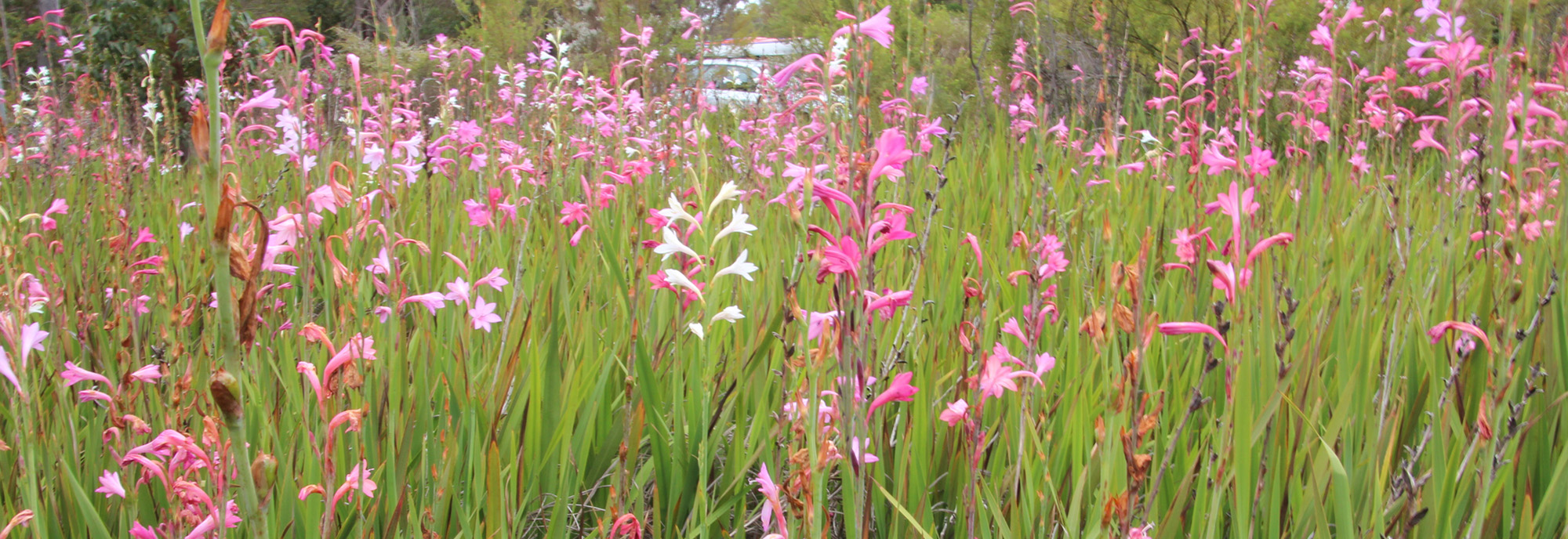

Watsonia spp.


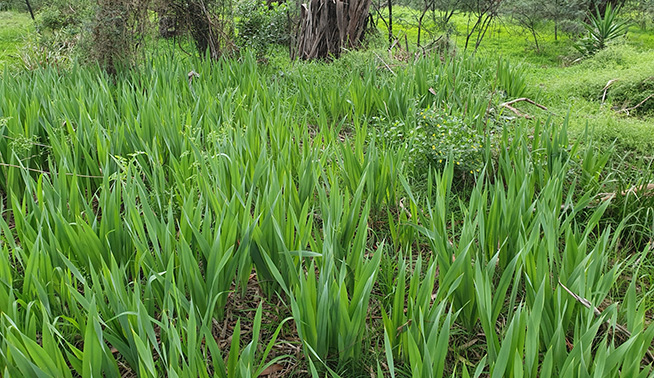
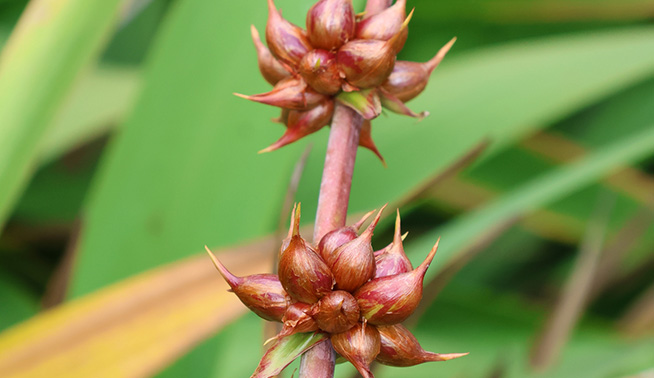
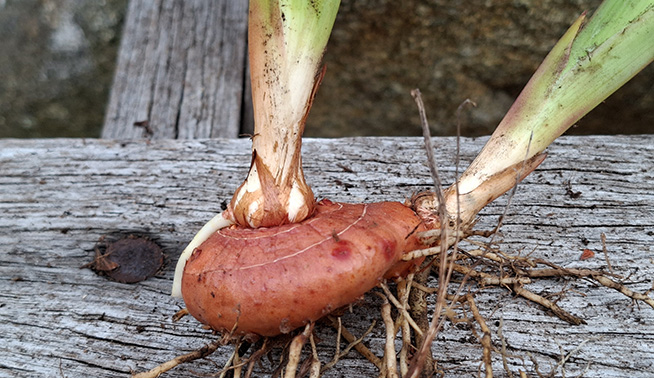
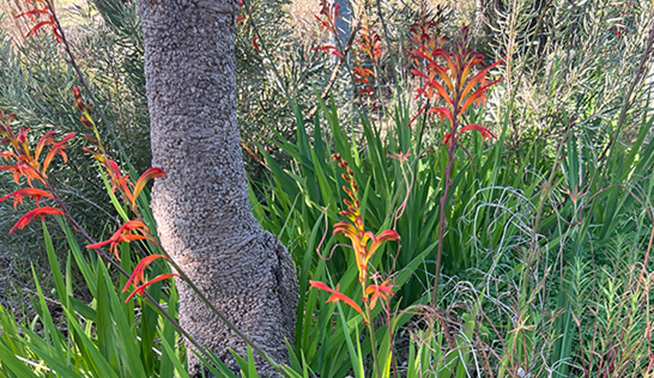
Plants can be manually removed during winter and spring when soils are moist. However, all bulbils must be carefully collected and removed off site to prevent further spread. As manual removal is labour-intensive and soil disturbance can encourage the establishment of other weed species, this method may be impractical for large infestations.
Slashing plants 10 cm or closer to the ground, before flowering can reduce corm reserves and prevent bulbil formation. While this method can help limit further spread, it will not eradicate established plants and resprouting is likely to occur.
For actively growing plants, spot spray with handgun or knapsack using glyphosate (450 g/L) with rate of 1L per 100L of water or wipe individual leaves with 10% dilution of glyphosate (450 g/L). Sponge application of glyphosate (450 g/L or 360 g/L) with a rate of 1L per 3L of water can be also effective. However, both wiping leaves and sponge application might be time consuming and not suitable for large and dense infestation.
For actively growing plants, spot spray metsulfuron-methyl (600g/kg) with a rate of 10g per 100L of water with 200mL of penetrant. Alternatively, a mixture of 1L glyphosate (450g/L) and 10g metsulfuron-methyl (600g/kg) in 100L of water is also effective for conservation areas and bushland.
For actively growing plants (just before flowering stem emerges), spot spray with a mixture of 100g 2,2-DPA (740g/kg) and 2.5 to 10mL of non-ionic wetting agent in 10L of water.
LSID number: [51438112] | full LSID: [https:/id.biodiversity.org.au/taxon/apni/51438112] | field_lsid: [] | taxon: [Watsonia meriana]
ALA Reference
 Department of Primary Industries and Regions. (2021)
Bulbil watsonia. Government of South Australia.
PlantNet. (n.d.).
Watsonia meriana (L.) Mill. PlantNET - FloraOnline.
Sydney Weed Network. (2024).
Watsonia (Watsonia meriana).
Western Australian Herbarium (2019).
Florabase—the Western Australian flora. Department of Biodiversity, Conservation and Attractions.
Wilson P.A. & Conran J.G. (1993)
The effect of slashing on the growth of Watsonia meriana (L.) Mill. cv bulbillifera in the Adelaide Hills. Plant Protection Quarterly, 8(3)
Department of Primary Industries and Regions. (2021)
Bulbil watsonia. Government of South Australia.
PlantNet. (n.d.).
Watsonia meriana (L.) Mill. PlantNET - FloraOnline.
Sydney Weed Network. (2024).
Watsonia (Watsonia meriana).
Western Australian Herbarium (2019).
Florabase—the Western Australian flora. Department of Biodiversity, Conservation and Attractions.
Wilson P.A. & Conran J.G. (1993)
The effect of slashing on the growth of Watsonia meriana (L.) Mill. cv bulbillifera in the Adelaide Hills. Plant Protection Quarterly, 8(3)
| JAN | FEB | MAR | APR | MAY | JUN | JUL | AUG | SEP | OCT | NOV | DEC | Notes | |
|---|---|---|---|---|---|---|---|---|---|---|---|---|---|
| Germination | |||||||||||||
| Flowering | |||||||||||||
| Active Growth | |||||||||||||
| Dormancy |
| JAN | FEB | MAR | APR | MAY | JUN | JUL | AUG | SEP | OCT | NOV | DEC | Notes | |
|---|---|---|---|---|---|---|---|---|---|---|---|---|---|
| Physical | |||||||||||||
| Chemical |


 Permit PER96570 for glyphosate