Other Common Names: Coast tea tree, Australian tea tree, tea-tree
Synonyms: Leptospermum laevigatum
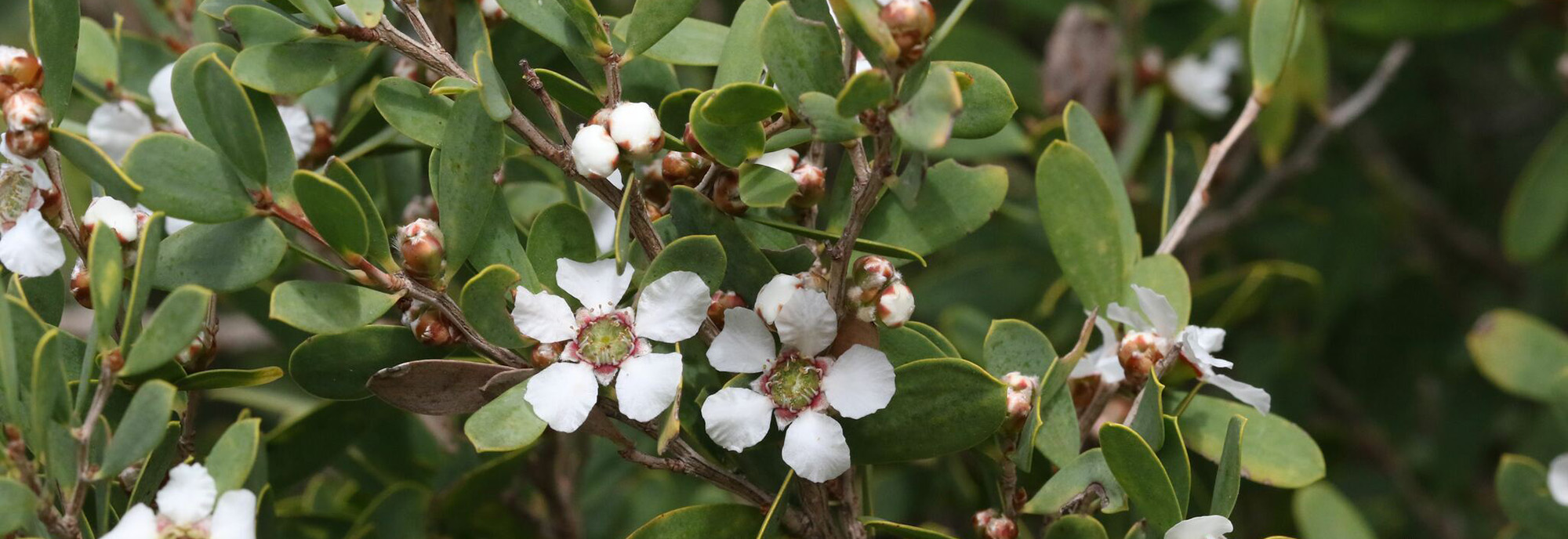

Gaudium laevigatum


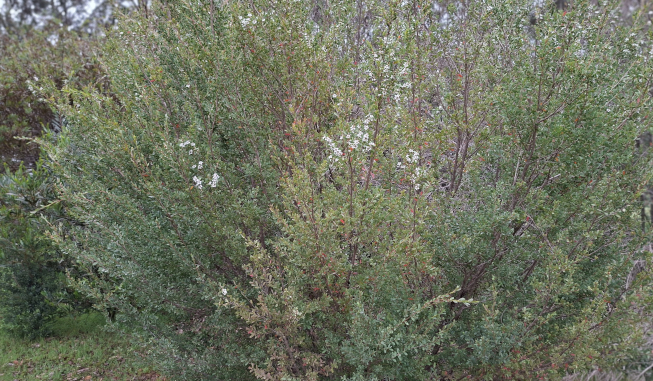
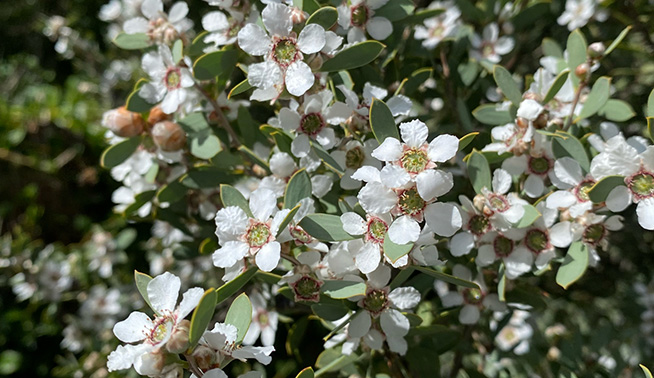
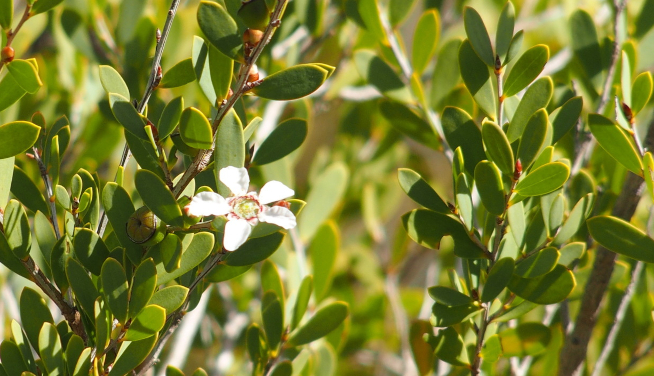
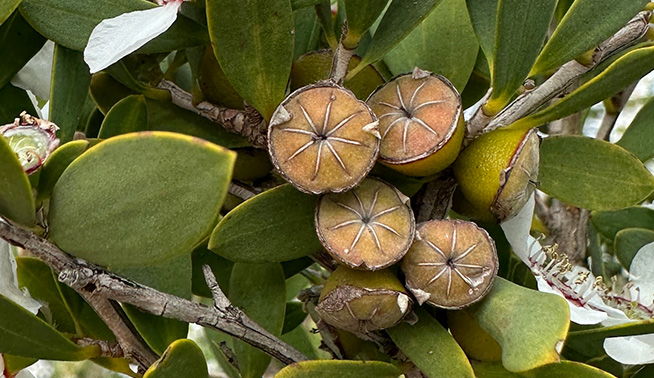
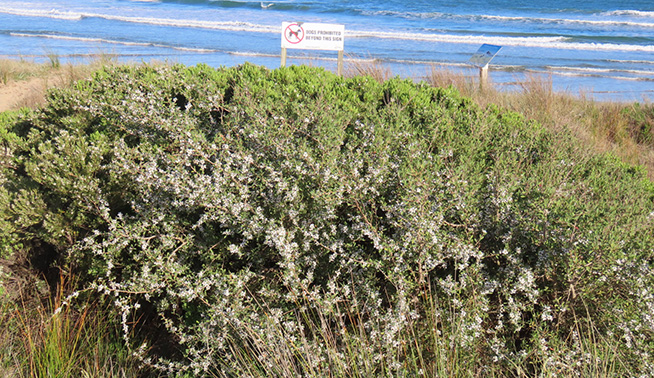
Do not treat Victorian tea tree while plants are fruiting. Stress from herbicide application or physical damage will trigger the fruits to release seed.
Manual removal is only effective for seedlings and small trees. Bigger plants can be cut with a hand saw or chainsaw, making sure to cut down close to the ground as possible and remove the cut trees from the site to prevent the resprout from the base. Follow up by monitoring the site periodically and remove the seedlings as necessary.
Foliar spray with 1-2% Glyphosate (360 g/L) or 1% solution of 300 g/L Triclopyr + 100 g/L Picloram + 8 g/L Aminopyralid. A penetrant should be used and spray until leaves are just wet. Spray regrowth the following year.
Cut stumps 50cm from the ground and Basal bark using Triclopyr (600g/L) or 240 g/L Triclopyr + 120 g/L Picloram at the rate of 1L/60L diesel to freshly cut stump surfaces and sides of trunks. Alternatively cut stump and paint with 50% solution of Glyphosate (360g/L).
A long acting soil herbicide could applied in areas where follow-up is difficult to organise. Apply 200 g/kg Tebuthiuron with the rate of 1-2 g/m2 by hand uniformly prior to winter rainfall once per year. Do not apply in areas where water run off is expected or in catchment areas.
Fire may kill adult plants, but prolific germination is expected post-fire.
LSID number: [2905839] | full LSID: [https://id.biodiversity.org.au/node/apni/2905839] | field_lsid: [] | taxon: [Leptospermum laevigatum]
ALA Reference
 Australian Plants Society (2020)
Gaudium laviegatum (syn. Leptospermum laevigatum) Coast Tea Tree. Accessed 9/8/2026
Denmark Weed Action Group (2012)
Victorian Tea Tree.
Department of Primary Industries and Regions (2021)
Coastal tea-tree
Lam, A., & Etten, E. V. (2002)
Invasion of indigenous vegetation in south-western Australia by Leptospermum laevigatum (Myrtaceae). Thirteenth Australian Weeds Conference. https://caws.org.nz/old-site/awc/2002/awc200215451.pdf
Messina, A. (2024)
Gaudium laevigatum (Gaertn.). VicFlora Flora of Victoria.
Moore, J., & Wheeler, J. (2008)
Southern weeds and their control. Department of Agriculture and Food, Western Australia.
Western Australian Herbarium (1998–)
Florabase—the Western Australian flora. Department of Biodiversity, Conservation and Attractions
Australian Plants Society (2020)
Gaudium laviegatum (syn. Leptospermum laevigatum) Coast Tea Tree. Accessed 9/8/2026
Denmark Weed Action Group (2012)
Victorian Tea Tree.
Department of Primary Industries and Regions (2021)
Coastal tea-tree
Lam, A., & Etten, E. V. (2002)
Invasion of indigenous vegetation in south-western Australia by Leptospermum laevigatum (Myrtaceae). Thirteenth Australian Weeds Conference. https://caws.org.nz/old-site/awc/2002/awc200215451.pdf
Messina, A. (2024)
Gaudium laevigatum (Gaertn.). VicFlora Flora of Victoria.
Moore, J., & Wheeler, J. (2008)
Southern weeds and their control. Department of Agriculture and Food, Western Australia.
Western Australian Herbarium (1998–)
Florabase—the Western Australian flora. Department of Biodiversity, Conservation and Attractions
| JAN | FEB | MAR | APR | MAY | JUN | JUL | AUG | SEP | OCT | NOV | DEC | Notes | |
|---|---|---|---|---|---|---|---|---|---|---|---|---|---|
| Germination | |||||||||||||
| Active growth |
Active growth all year
|
||||||||||||
| Flowering | |||||||||||||
| Fruiting |
Fruits may be present all year
|
| JAN | FEB | MAR | APR | MAY | JUN | JUL | AUG | SEP | OCT | NOV | DEC | Notes | |
|---|---|---|---|---|---|---|---|---|---|---|---|---|---|
| Physical | |||||||||||||
| Chemcial |
Do not treat while fruiting
|


 PER96570 - Glyphosate